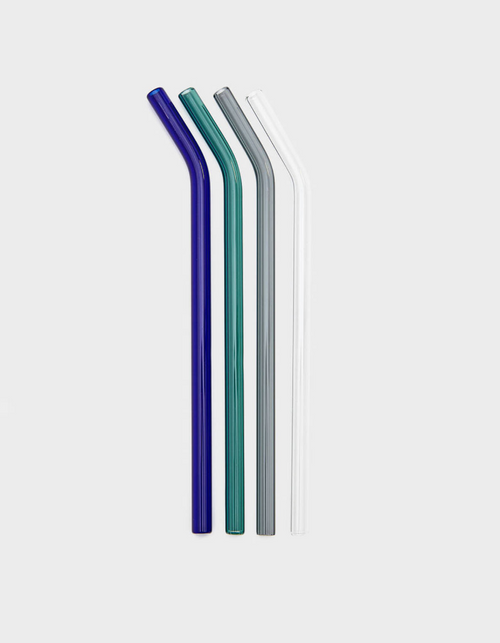
Most things described as sustainable come with a small tax. A performance that's slightly worse, a texture that's slightly off, a reminder — however subtle — that you are making the responsible choice rather than simply the best one.
Glass straws are an exception to this in almost every way that matters.
They are cleaner to drink from than plastic, which absorbs taste over time and eventually, however slowly, degrades. They are more pleasant than metal, which conducts temperature and leaves a faint mineral note in anything delicate — a good juice, a long drink, something sparkling. Glass is neutral. It doesn't add anything. It lets the drink be itself.
There is something worth noting about an object that asks nothing of you — no adjustment, no compromise — but simply works better than what it replaced.
They are also, if you care about such things, beautiful. Clear glass catches light in a way that no other material does. On a table, in a glass, in a kitchen that you've put some thought into — they look like they belong. Not as a statement about the environment, but as a considered object in a considered space.
The practical questions
Fragility is the obvious concern, and it's a fair one. Borosilicate glass — the same material used in laboratory equipment, in good cookware, in objects designed to endure — is significantly stronger than it looks. It handles temperature change without cracking and takes a reasonable amount of everyday handling without incident.
That said, glass straws are not indestructible and don't pretend to be. They should be stored somewhere they won't roll, used with a little care, and not handed to a three-year-old. Kept sensibly, they last for years. Some people have had theirs for a decade.
Cleaning
A small cleaning brush — usually included — and warm soapy water is all they need. Thirty seconds after each use, and they're done. They can go in the dishwasher, though the brush is gentler and more effective. The glass doesn't hold residue, doesn't absorb flavour, and doesn't develop the faint smell that reusable plastic eventually acquires no matter how carefully you wash it.
This is, it turns out, one of the more underrated things about glass as a material: it stays clean in a way that other materials don't.
What they're for
Cold drinks, mostly — water, juice, smoothies, sparkling anything. They work particularly well in wide-mouth glasses and tumblers. They are, if you're making something worth presenting, the finishing detail that makes a drink look as considered as it tastes.
Not every small change needs to be a declaration. Sometimes it's just a better object, chosen once, used indefinitely.
There's a version of sustainability that requires vigilance — constant auditing of choices, ongoing sacrifice, a kind of moral maintenance that is exhausting to sustain. And then there are objects like this: chosen once, used indefinitely, better in every measurable way than what they replaced.
That's the kind of change that actually sticks.